

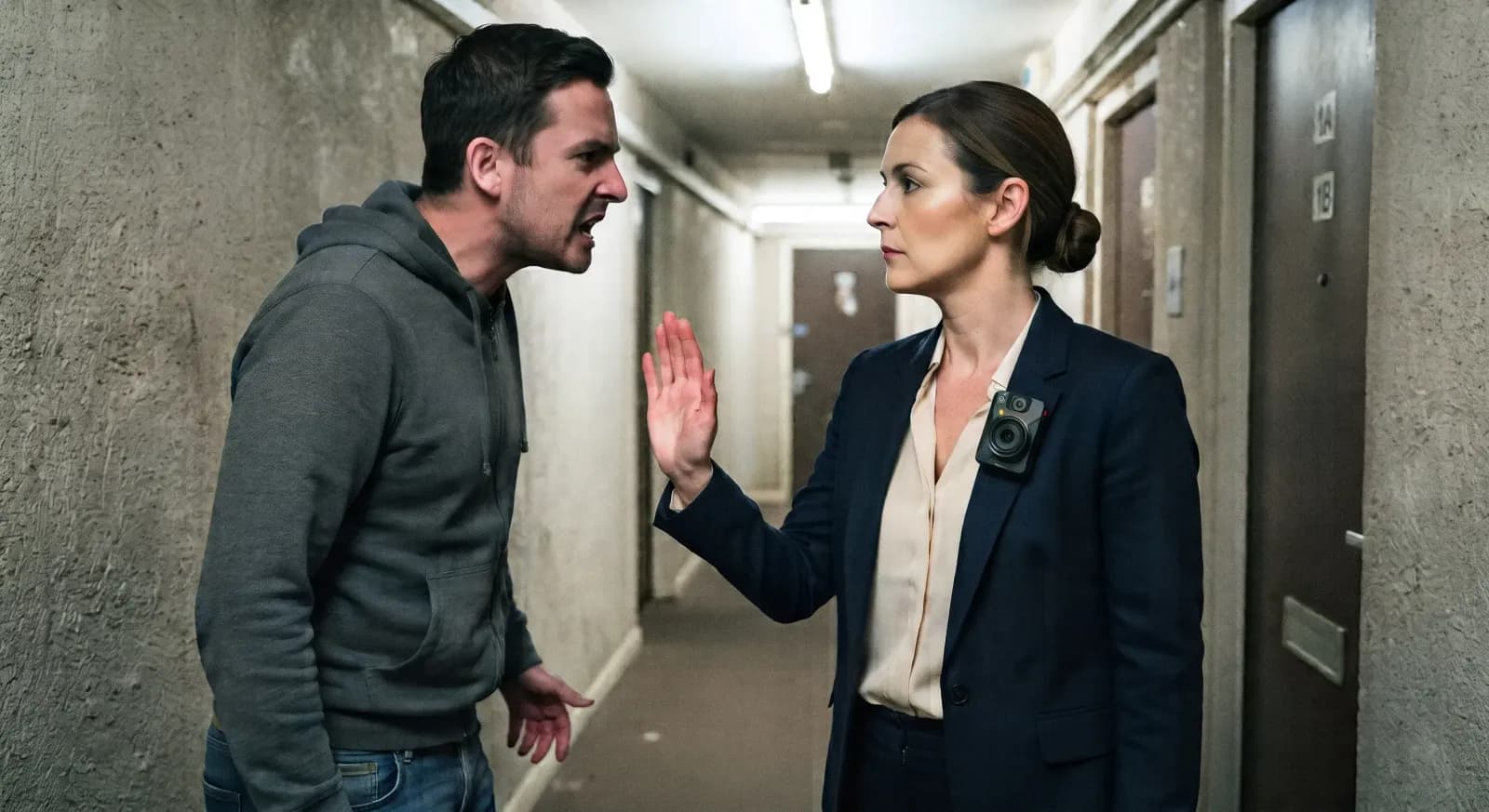
Body-worn video is an evidence device, not an alarm
This distinction matters more than any specification. A camera records what happens. It does not summon help, alert a monitoring centre, share a location or escalate when a worker stops responding. Organisations sometimes buy body-worn video expecting it to cover lone working risk, then discover it answered a different question. Where the foreseeable risk is a worker needing assistance, a monitored lone worker device or app addresses that. Where the risk is disputed accounts, under-reported abuse or evidence for enforcement, body-worn video addresses that. Many frontline roles have both risks, and they need both answers.

- A camera does not raise an alarm. Do not let it substitute for one.
- Decide which problem the deployment is solving before comparing products.
- Where both risks exist, plan for both rather than assuming one covers the other.
The deterrent effect is real but uneven
Visible recording, announced clearly, changes some behaviour. It works least well where it is needed most: where a person is in crisis, intoxicated, or beyond weighing consequences. Training and de-escalation still carry the situation. Treat body-worn video as one control among several, not as the control.
- Deterrence depends on the camera being visible and the recording announced.
- Expect least effect in exactly the encounters that most concern you.
- Staff still need the skills to de-escalate without relying on the device.
What the research actually shows
One figure dominates body-worn video marketing: a randomised trial at Rialto Police Department in California, published by Ariel, Farrar and Sutherland in 2015, found roughly a 50 per cent fall in use of force and a 90 per cent fall in complaints, with both still evident four years later. That figure is widely repeated as proof that cameras reduce violence against staff. It does not show that. The reduction measured was in force used by officers, not force used against them, and the two are routinely conflated in supplier material. The broader picture is more mixed than any single trial suggests. A Campbell Collaboration systematic review by Lum and colleagues examined 71 studies and found effects on use of force inconsistent, with trials in Washington DC, Denver, Milwaukee, Birmingham and Edmonton reporting no significant effect. The finding that holds up most reliably is the fall in complaints, although researchers are careful to note it is unclear how much reflects better interactions and how much reflects changed reporting behaviour.
- The widely quoted 50 per cent figure measured officers' use of force, not assaults on staff. Check any supplier who cites it.
- Effects on violence and aggression are inconsistent across the wider literature, not settled.
- Reduced complaints is the most robust finding, which supports the evidential case for body-worn video rather than the preventive one.
- Most of this research studies police officers. Applying it directly to housing, health or enforcement staff is a further step that the studies do not take.
- Sources: Ariel, Farrar and Sutherland, Journal of Quantitative Criminology, 2015; Lum and colleagues, Campbell Systematic Reviews, 2020. Checked August 2026.
How staff use it decides whether it works
A camera left switched off until someone is already shouting has missed the part that explains the incident. The behaviour that matters, and the evidence that stands up later, is usually in the approach and the first exchange. Activating early and announcing it plainly is what converts a device into a deterrent. How that announcement is worded matters too: framed as fairness to both parties, it tends to settle an encounter, where framed as a warning it can escalate one.
- Turn it on early, at the start of an interaction that could escalate, not once it has.
- Wear it visibly. A concealed camera deters nobody and raises the legal bar considerably.
- Announce it in terms of fairness to both parties rather than as a threat.
- Withdrawing to safety remains the right call at any point. Staff are not required to win the argument, and a recording is no substitute for leaving.
Pre-record buffers change what you are actually recording
Most current cameras hold a rolling buffer, so pressing record also saves the seconds immediately before it. Devices vary, from around ten or fifteen seconds to a minute or more, and the length is often configurable. Operationally this is valuable, because it captures the approach and the first words that explain how an incident began, which is precisely the part staff miss when they activate late. It has a consequence employers frequently overlook: to offer that buffer, the camera is capturing continuously whenever it is powered on, discarding rather than saving. Your Data Protection Impact Assessment should say so, because describing the deployment as incident-triggered while the device is always capturing is inaccurate. Many buffers hold video only and begin audio at the moment of activation, which is a deliberate and sensible default, and one worth confirming rather than assuming.
- Find out your device's buffer length and whether it can be configured, then record the setting and the reason for it.
- Confirm whether the buffer captures audio. Video-only pre-recording is easier to justify.
- Reflect the buffer in your DPIA and privacy information. The camera is capturing whenever it is on, not only when recording.
- Tell staff the buffer exists. It reduces the pressure to activate at exactly the right instant, and stops them assuming a late activation lost everything.
What to say when recording starts
Staff need a form of words they can use without thinking about it, because the moment they need it is the moment they have least capacity to compose one. The wording below is used by frontline teams and works because it makes the camera mutual rather than accusatory. It is worth practising out loud in training, since reading a script and delivering it under pressure are different skills.
- "This is a measure of me as much as it's a measure of you, to make sure I treat you fairly as much as you treat me fairly. It captures what's said and what's done."
- Say it once, clearly, and carry on with the interaction rather than debating the camera.
- If asked to switch it off, explain why it stays on rather than negotiating.
- Record in training what staff should do if someone objects, so nobody improvises it alone.
Footage protects the wearer as often as it convicts
Staff sometimes read body-worn video as employer surveillance, and the honest answer is that it records them too. The practical counterweight is that a recording is frequently what clears a member of staff when an account is disputed or a complaint is made. Where an organisation intends to use footage to defend its people, saying so explicitly does more for adoption than any specification. Footage also raises the evidential quality of a report, which is what allows employers and police to act on abuse rather than log it.
- Say plainly that footage will be used to defend staff against unfounded complaints.
- A recorded account removes the his-word-against-mine problem that stops many reports progressing.
- Better evidence is what turns a reported incident into an outcome, whether that is a prosecution, a warning, a banning order or an internal sanction.
Deploying it makes you a surveillance operator
Body-worn video captures personal data, so the UK GDPR and the Data Protection Act 2018 apply, and the Information Commissioner's Office regulates it. Because the processing is systematic, involves people who cannot easily avoid it and often captures sensitive situations, a Data Protection Impact Assessment is normally expected before deployment rather than after. The ICO publishes guidance on video surveillance covering body-worn devices, and reading it before you buy is considerably cheaper than reading it after a complaint.
- Complete a DPIA before deployment, not once cameras are already in use.
- Identify your lawful basis. Consent is rarely workable, because a member of the public in an incident cannot meaningfully refuse.
- Record the decision, including why less intrusive options were rejected.
Continuous recording is harder to justify than incident-triggered
A camera running for a whole shift captures a great deal that has nothing to do with any incident: colleagues, bystanders, homes, conversations, clinical or personal circumstances. Recording only when an interaction escalates is more proportionate, easier to defend and generates far less material to store, redact and review. Audio raises the bar again, being more intrusive than image alone and more likely to capture people outside the encounter.
- Prefer incident-triggered recording unless continuous capture is specifically justified.
- Treat audio as a separate decision requiring its own justification.
- Be explicit about whether staff can start, stop and mark recordings, and when.
- Account for the pre-record buffer separately. It sits between incident-triggered and continuous, and needs its own justification.
Transparency in practice, not just in policy
People must know they are being recorded. In practice that means the device is visible rather than concealed, staff say clearly that recording has started, and the organisation publishes information explaining what is recorded, why, how long it is kept and how someone can request a copy. Covert recording sits under a much stricter regime and should not form part of routine deployment.
- Make the device visible and the announcement routine, not discretionary.
- Publish the privacy information rather than holding it internally.
- Give staff the exact words to use when recording starts, and practise them.
Retention and access are the ongoing cost
Footage cannot be kept indefinitely because it might one day be useful. Set a defined retention period, justify it, and enforce deletion automatically rather than by intention. Plan for subject access requests: someone recorded has a right to their data, and supplying it usually means redacting other identifiable people from the footage. That is slow, skilled work, and the volume scales with how much you record, which is another argument for incident-triggered capture.
- Set a retention period, automate deletion, and audit that it happens.
- Extend retention only for a specific, recorded reason such as an investigation.
- Budget the staff time for access requests and redaction before you deploy.
Staff are affected too, and should be consulted
Body-worn video records the wearer as much as the public. It captures how staff speak, the decisions they take under pressure and their mistakes. Deployed without consultation it reads as monitoring rather than protection, and adoption suffers accordingly. Be clear from the outset whether footage may be used in performance or disciplinary matters, because staff will assume the worst if the answer is left vague.
- Consult staff and their representatives before deployment, not after.
- State plainly whether footage can be used in performance or conduct processes.
- Give staff a route to raise concerns about how recordings are used.
Questions worth settling before you buy
Most difficulties with body-worn video are decided at procurement rather than in the field. Work through the operational questions with the teams who will wear the devices, and keep the answers with your DPIA so the reasoning survives a change of manager.
- Which roles and which situations, and who decides in the moment?
- Continuous or incident-triggered, and with or without audio?
- Who can view footage, on what authority, and is access logged?
- How long is it kept, and what triggers a longer hold?
- Who handles a subject access request, and how long will redaction take?
- What happens when a device fails, or a recording is missing after an incident?
The short version
What to take away
- Body-worn video records an incident. It does not summon assistance, so it does not replace a monitored lone worker device where the risk is a worker needing help.
- Activate early and announce it plainly. A camera switched on once someone is already shouting has missed the part that explains the incident.
- Give staff a form of words for the announcement and practise it. Composing one under pressure is not realistic.
- Withdrawing to safety remains the right call at any point. Staff are not required to win the argument.
- The often-quoted 50 per cent reduction measured police officers' use of force, not assaults on staff. Evidence that body-worn video reduces violence against workers is mixed.
- A pre-record buffer means the camera captures continuously whenever it is powered on. Reflect that in the DPIA rather than describing the deployment as incident-triggered.
- A Data Protection Impact Assessment is normally expected before deployment, not after.
- Incident-triggered recording is easier to justify than continuous recording, and generates far less material to store and redact.
- Audio is more intrusive than image and needs its own justification.
- Retention periods must be defined and enforced. Footage cannot be kept in case it proves useful.
- This guidance is a practical starting point for employers. It is not legal advice, and it does not replace your own DPIA, policy or professional advice where the position is uncertain.
Discuss your requirements
Ready to equip your team with practical safety skills?
Contact our team to discuss your training needs, review course options, or request a clear, no-obligation proposal.
Practical recommendationNo obligationUK-wide delivery